E155 Project: RFID Jukebox
Project Abstract
In this project, we sought to create an RFID-card controlled jukebox. A user would be able to tap an RFID-card onto an RFID reader, and the jukebox would play songs corresponding to the specific card that was tapped. Songs would be loaded on an SD Card, and read and transmitted to a speaker using a DFPlayer. An LED light string would display a light show corresponding to the song that is played. A servo motor would move a “needle” on a record to emulate a real jukebox.

System Design
The block diagram for the system is given below: 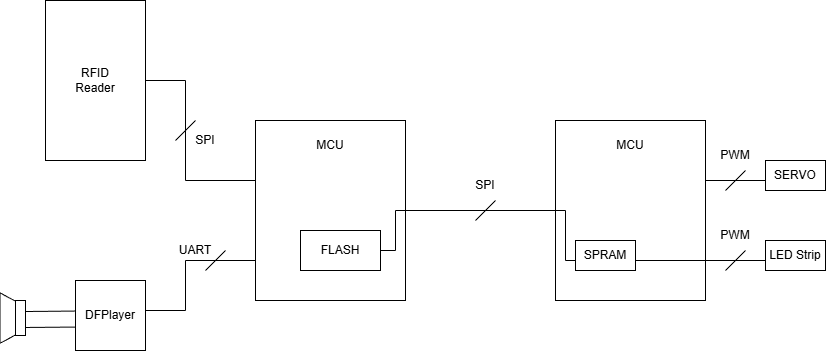
New Hardware
RFID Reader
The RFID reader was a new sensor that we had not previously seen in this class. It communicated to the MCU via SPI. One of the main challenges and new things we learned in regards to this sensor was how to use and translate libraries. This sensor is fairly common in a lot of beginner RFID projects on Arduino, and so there was a lot of code and libraries out there to help get the sensor up and running. However, Arduino is in C++ and we were using C. So we had to translate massive libraries into C code. This task greatly improved our C code writing abilities and strengthened our knowledge of the intricacies of the language C.
DFPlayer
Another piece of new hardware we used was the DFPlayer Mini, another popular Arduino component. This device used USART to communicate a string of numbers which correlated to files on the SD card. It translated the MP3 files on the SD card to signals to be transmitted to a speaker.
LED Light Strip
A new piece of hardware we implemented on the FPGA was a light strip. We used WS2812 individually addressable LEDs. The entire strip was controlled using a PWM signal, which communicated RGB values to each of the individual lights. We created an FSM that would take the given color sequence and shifted them throughout the length of the strip. We wanted to give the lights the color sequence through SPRAM but were unable to implement this before we experienced hardware issues.